The Computerized Tuberculosis Surveillance System in Japan
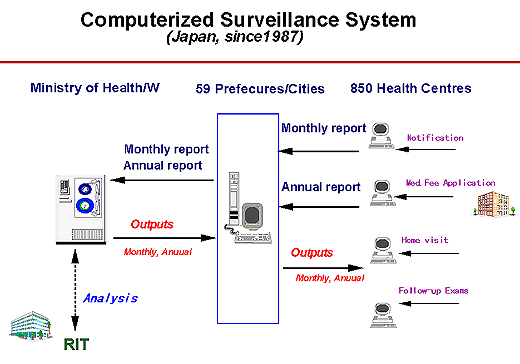
The computerized tuberculosis surveillance have been carried out since 1987 in Japan. The surveillance system consists of a three-phase structure, the health center level, the local government level, and the Ministry of Health and Welfare (MOHW). MOHW is technically strongly supported by the Research Institute of Tuberculosis (RIT), Japan Anti-Tuberculosis Association (JATA), as can be seen in Figure. As of 1994, there are 844 health centers, 47 prefectures and 12 Metropolitan Cities as local government in Japan.
The individual data consist of the items such as sex, age, occupation of the patient, present bacteriology and X-ray findings and those at the time of registration, chemotherapeutic regimen, date of negative conversion and so on, which are recorded at each health center by the clerk, public health nurse or someone else. The individual data on the newly registered in the course of a month are to be accessed and sent to the local government by 10th of the following month, on-line. The local government should send the individual data to MOHW before 15th, on-line.
The results of the analysis are sent back to the local health center through local government up to 20th on-line. Results are distributed to the public through the monthly official journal of the Japanese Society for Tuberculosis, Kekkaku.
The results of the analysis of the registered patients are published as Tuberculosis Year Book. A total of 50 tables including the distribution of patient's, doctor's and total delay, of initial chemotherapeutic regimen, and of the duration of hospitalization; chemotherapy and registration; treatment results and so on, are included in the routine analysis at national level.
As the Directors of every health center have the direct responsibility for tuberculosis control measures in the area, the analysis of data collected at the health center level is very important. For this purpose, 43 programs to be used for analysis are prepared at each health center. Programs for print-out of special cases such as bacteriologically positive cases for one year or more after registration, registered 5 years earlier or more, and so on, are included. Analysis of the patient's, doctor's and total delay, analysis of treatment duration can be also done with the program available at the health center.
Further analysis of the collected data is carried out at prefecture level by the 50 programs already distributed to the local government to support the health center activities.
Precise analysis of the collected data is to be conducted at the RIT,JATA. The National Tuberculosis Surveillance Committee is organized by tuberculosis specialists and a committee meeting is to be held at any time if needed.